StratifIAD develops explainable artificial intelligence approaches for computational histopathology, focusing on the localization, characterization and interpretation of tau and amyloid-beta aggregates in Alzheimer’s disease whole-slide histopathology.
Research Themes
Project Overview
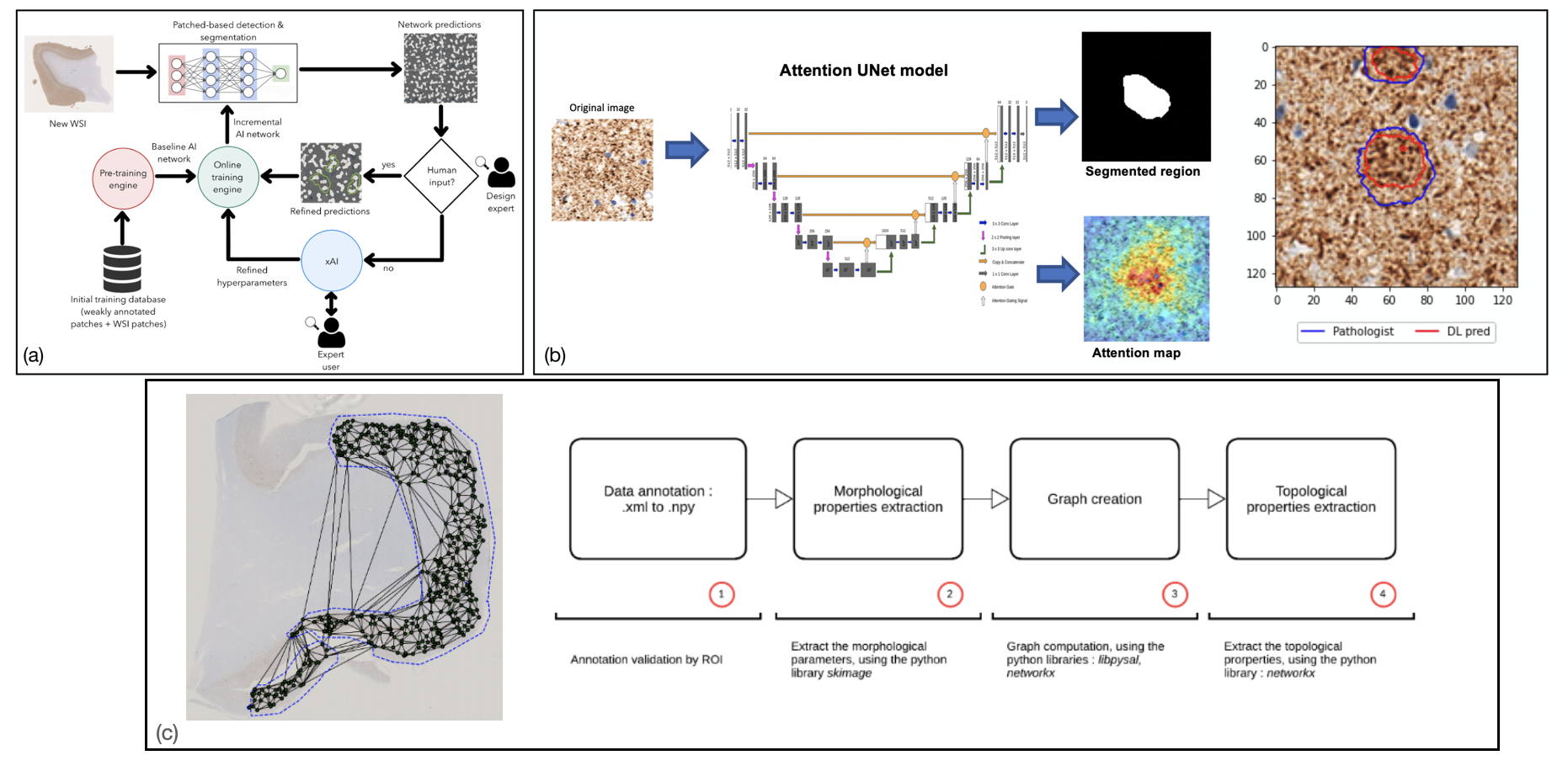
The project aims to develop algorithms for fully automated localization and characterization of tau and amyloid-beta aggregates in histological images of the human brain.
The morphology and spatial organization of these aggregates are highly heterogeneous. Amyloid-beta accumulation may appear as focal deposits or diffuse plaques, whereas tau lesions can form neurofibrillary tangles and neuritic structures with complex topological organization.
Scientific Objectives
- Develop deep learning models with explainability mechanisms for segmentation and interpretation of brain tissue histopathology.
- Build cloud-based platforms for visualization, annotation refinement and collaborative analysis of whole-slide images.
- Explore graph-based models for representing morphology and topology of tau-related structures.
- Improve patient stratification through interpretable computational biomarkers.
Scientific Vision
StratifIAD investigates how explainable AI can support computational pathology not only as a prediction tool, but also as a scientific instrument for understanding disease heterogeneity and tissue organization.
The project places strong emphasis on traceability, interpretability and reproducibility, with the objective of developing clinically meaningful AI systems that remain compatible with expert-driven histopathological analysis.
Resources
Selected Publications
-
A meta-graph approach for analyzing whole-slide histopathological images of human brain tissue with Alzheimer’s disease biomarkersGabriel Jimenez, Pablo Mas, Anuradha Kar, Julien Peyrache, Lea Ingrassia, Susana Boluda, Benoît Delatour, Lev Stimmer, Daniel Racoceanu — SPIE Medical Imaging 2023.
-
Visual Deep Learning-Based Explanation for Neuritic Plaques Segmentation in Alzheimer’s Disease Using Weakly Annotated Whole Slide Histopathological ImagesG. Jimenez et al. — MICCAI 2022.
-
Improving segmentation quality with fusion based post-processing: an assessment with 3D deep learning and classical segmentation pipelinesA. Kar — CVPR-CVMI 2022.
-
Interpretable Deep Learning in Computational Histopathology for refined identification of Alzheimer’s disease biomarkersGaray, Kar, Ounissi, Stimmer, Delatour and Racoceanu — AAIC 2022.
-
A deep learning framework for stratification of Alzheimer’s disease patients using whole-slide histopathological brain tissue imagesKar, Jimenez, Ounissi, Stimmer, Delatour and Racoceanu — ECDP 2022.
-
Empowering Researchers for Understanding Alzheimer’s Disease using Explainable AIJimenez, Kar, Ounissi and Racoceanu — AI4Health Winter School 2022.